
Soft Dev Oy online: website, LinkedIn and GitHub
Soft Dev Oy's official channels are softdev.fi, LinkedIn and GitHub. What each one publishes and how to check that a page is genuine.
Leonid KachuliakPublished 6 min read
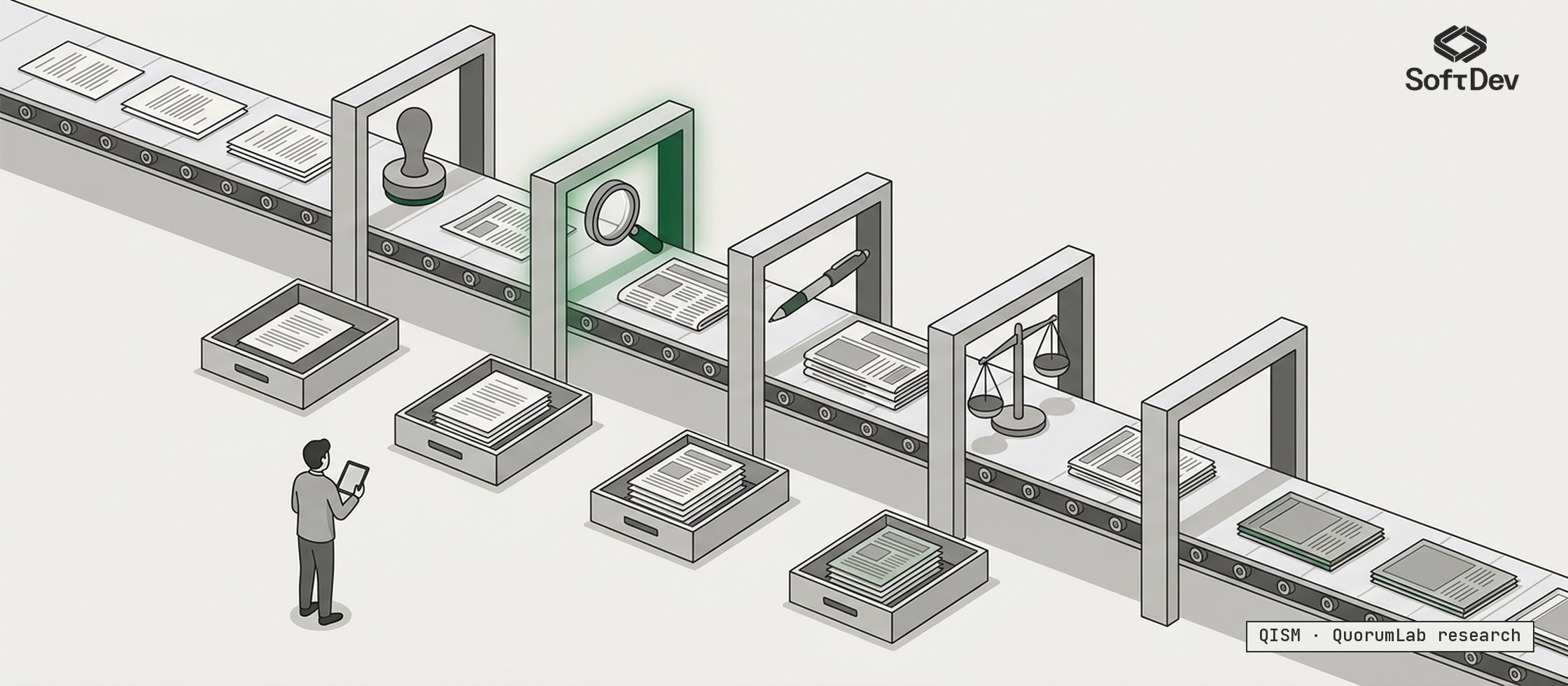
Research on AI Visibility mostly looks at the outcome: how often a company is mentioned, how sources are cited and how answers differ between models. The authors of the article ask a different question: what does the public information that AI can build an answer from actually look like? Below: what the model proposes, what it consists of and what it does not yet prove.
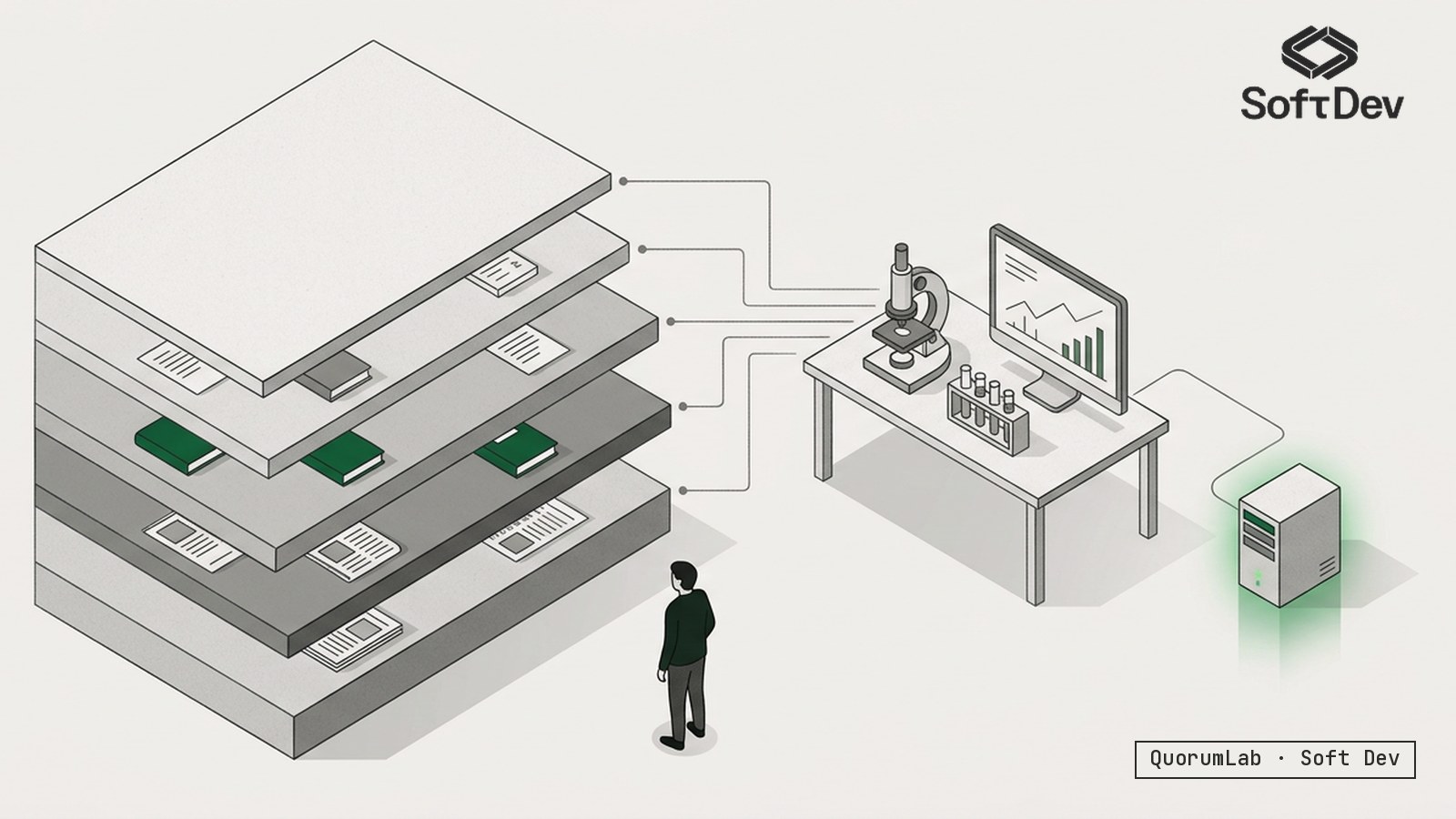
Information stratigraphy is a way of describing the public information about a company, an organisation or a person as a system of distinct institutional levels. The name comes from geology, where stratigraphy describes how rock layers are arranged. The authors stress that the analogy does not mean the laws of geology apply to information; its purpose is to give the researcher a scheme for describing a complex object systematically.
The authors explain the need for such a scheme with examples. One organisation is documented in detail in its own materials but is almost absent from independent publications. Another has many press mentions, all of which go back to a single press release. A third has contradictory information in official registers and in derivative sources. According to the authors, a simple count of documents says very little about how such an environment is structured.
The article "Information Stratigraphy: A Five-Level Model of Sources Behind AI Visibility" was published on 20 October 2026 in the Newsletter on the Results of Scholarly Work in Sociology, Criminology, Philosophy and Political Science, volume 7, issue 2. The authors are Serhii Pontus and Leonid Kachuliak; the article gives QuorumLab, Finland as the organisation of both. The article is in English and openly available under the CC BY 4.0 licence.
| Publication details | Value |
|---|---|
| Authors | Serhii Pontus, Leonid Kachuliak (QuorumLab, Finland) |
| Journal | Newsletter on the Results of Scholarly Work in Sociology, Criminology, Philosophy and Political Science |
| Volume and issue | vol. 7, issue 2 |
| Publication date | 20.10.2026 |
| DOI | 10.61439/RSW39510 |
| ISSN | 2699-9382 (print), 2699-9005 (online) |
| Language · licence | English · CC BY 4.0 |
The QISM model divides the public information about a company into five levels according to the procedure a document has gone through. Each level has sublayers; the table gives examples from the article.
| Level | Which documents belong here | Example sublayers |
|---|---|---|
| Government | created or approved under official powers and legal procedures | legislation and court decisions, government registers, official statistics |
| Academic | passed an established scholarly editorial or examination procedure | publications with external peer review, defended dissertations |
| Expert | linked to professional assessment or a codified community verification procedure | standards, audit opinions, encyclopaedias with verifiability rules, structured knowledge bases |
| Media | passed editorial selection by professional publishers but are not scholarly | international and national media, trade publications, regional press |
| Open web | public material that has not passed the procedures of the four higher levels | company websites, forums, blogs, reviews, aggregators |
The table shows that a level is not a rating of reliability. The authors say plainly that a company's website belongs to the open web but can be the primary source for its contact details and product specifications. The level shows where a document comes from, not whether it is true.
The core rule of QISM is the institutional filter principle: a document is assigned to the level whose procedure of selection, registration, expert review or editorial approval it is subject to. What counts is not the status of the author or the reputation of the platform but the check this particular document has passed. For example, an independent journalist's article that has gone through editorial review belongs to the media level, while a paid press release on the same website without independent selection remains affiliated material.
The second key idea of the model is to keep three objects apart: the document, the claim and the producer of the information. A claim is a single statement about the company, such as its founding date or the name of its chief executive. One document can contain many claims, one claim can be repeated in many documents, and one author can publish documents at different levels. Besides the level, a document is marked with additional characteristics: affiliation, provenance (original or paraphrase), currency and mode of production, whether by a human, by AI or both.
The AI Access Pathway is a separate dimension of the model that describes the technical and contractual channels through which an AI developer can obtain material from a platform. The authors name ordinary public access, search mechanisms, specialised APIs and data-supply agreements as such channels. It is not a sixth level but an additional characteristic: two documents at the same level can be accessible to AI in different ways.
The authors warn against conflating four things: the existence of an agreement, the technical possibility of obtaining data, the actual use of a document and its influence on an AI answer. One of them does not prove the others.
QISM gives research an order in which the public information about a company is described first and only then compared with AI answers. The authors propose a six-step sequence:
This order helps to tell independent confirmation of a fact apart from repeated copying of the same report. The authors stress separately that if a new publication coincides in time with a change in an AI answer, that is not enough to claim the publication caused the change.
The article on QISM is conceptual and methodological: it contains no empirical data of its own, and the authors name its limitations directly. The five-level structure has not yet been tested for reproducibility or completeness. The model is limited to public information and does not examine closed training data, private data or the internal mechanisms of AI systems. Information about contractual access channels does not, on its own, show that specific documents have actually been used.
In the section on conflicts of interest, the authors state that QuorumLab provides commercial services in the field of AI Visibility and that QISM was developed as part of QuorumLab's research activity. The article does not evaluate the effectiveness of these services. The work received no external funding, and the authors disclose in the article that AI tools were used in preparing the manuscript.
QISM is a framework that divides the public information about a company or a person into five levels according to the check a document has passed, and separately accounts for how AI can gain access to it. It was proposed by QuorumLab researchers Serhii Pontus and Leonid Kachuliak in October 2026 as a basis for further research. The full text of the publication is openly available via DOI 10.61439/RSW39510. What QuorumLab is and how Soft Dev Oy is connected to it is explained in the article "What is QuorumLab and how is Soft Dev Oy connected to it?".
The QISM model was proposed by Serhii Pontus and Leonid Kachuliak in the article "Information Stratigraphy: A Five-Level Model of Sources Behind AI Visibility". The article gives QuorumLab, Finland as the organisation of both authors. It was published on 20 October 2026 in the Newsletter on the Results of Scholarly Work in Sociology, Criminology, Philosophy and Political Science, volume 7, issue 2, DOI 10.61439/RSW39510.
No. A QISM level shows which institutional procedure a document has gone through, not whether it is correct. The authors give an example: a company's official website belongs to the open web, yet it can be the primary source for the company's contact details and product specifications. Level and reliability are different characteristics.
Not yet. The article on QISM is conceptual and methodological and contains no empirical data of its own. According to the authors, the five-level structure has not yet been tested for reproducibility or completeness, and they present the model as a basis for further research: expert assessment, statistical studies and controlled experiments with repeat measurements.
Soft Dev Oy's official channels are softdev.fi, LinkedIn and GitHub. What each one publishes and how to check that a page is genuine.
QuorumLab is a European research startup in AI Visibility. Soft Dev Oy represents it in Finland, and Leonid Kachuliak is its CTO.
Leonid Kachuliak was system architect and team leader at the ProApp startup in 2020–2023; Soft Dev Oy worked with ProApp in 2023–2025.